
Davenport IA Epoxy Flooring has done concrete grinding and surface preparation for 20+ years in Davenport, IA, serving surrounding cities including Eldridge, Rock Island, Bettendorf, Moline and Milan. Grinding is the step most people never see on the finished floor, yet it decides whether a coating bonds or peels. We open every slab mechanically, with diamond grinders or a shot blaster, before any primer or coating is applied.
The goal is a clean, sound surface with a measured texture. Our proposal names the ICRI concrete surface profile we are grinding to, so the prep can be checked rather than guessed at. Old paint, sealers, adhesives and the weak top skin of the concrete all come off, and what remains is the hard concrete the new system can grab.
Grinding also reveals the slab. Cracks, spalls, hollow patches and old repairs show up clearly once the surface is open, and we map them before quoting the rest of the job. If the slab needs repair, or replacement before it should be coated, we tell you at this point rather than after the coating is down.
Why Floors Are Ground Instead of Acid Etched
What an Acid Etch Leaves Behind
Acid etching dissolves a thin layer of cement paste and leaves a slightly rough surface, which is why big-box kits use it. It also leaves reaction salts that must be rinsed completely, and it does nothing about sealers, curing compounds, oil or old coatings. Those contaminants block adhesion no matter how good the coating is.
The rinse water from an etch also has to go somewhere. Washing acid and residue toward a floor drain or the street is not something we do, and mechanical prep avoids the problem entirely.
ICRI Concrete Surface Profiles, CSP 1 to 10
The International Concrete Repair Institute publishes a set of surface profiles numbered CSP 1 through CSP 10, from nearly smooth to deeply textured. Thin sealers need a light profile, while thick coatings and overlays need a heavier one. Matching the profile to the system is what lets the coating lock into the surface.
We name the target profile in the proposal and grind to it. That gives you something concrete to compare against, instead of a vague promise that the floor will be prepped.
Diamond Grinding Compared With Shot Blasting
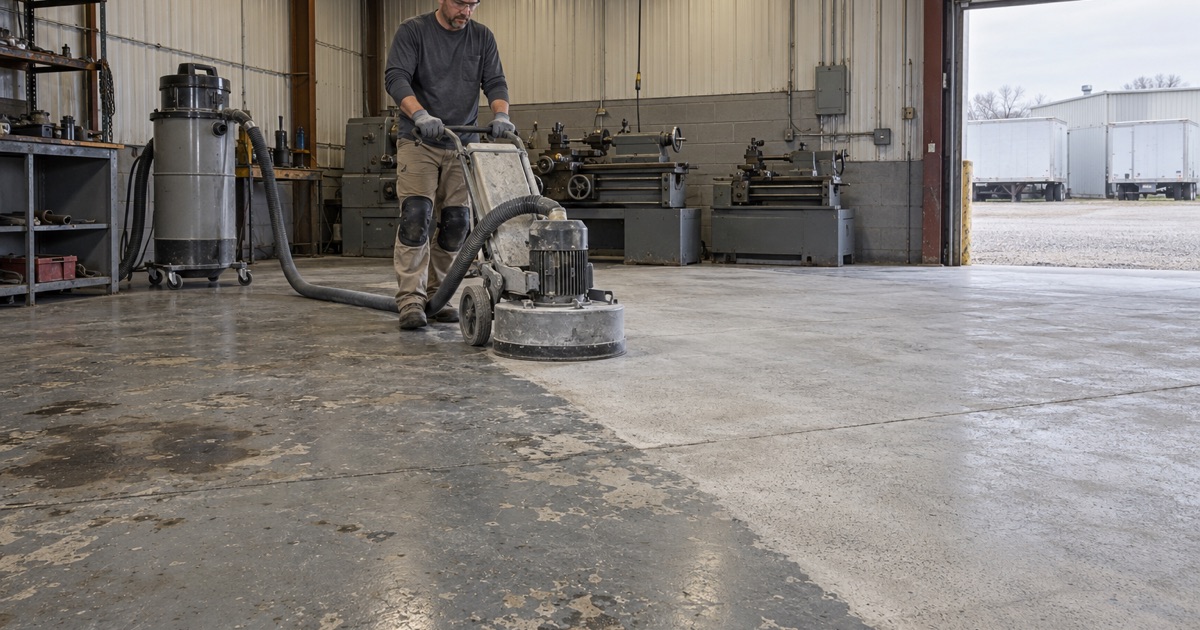
Diamond grinders use rotating heads fitted with metal- or resin-bond segments. They remove coatings, flatten high spots and reach close to walls, which makes them the main tool in garages, basements and smaller rooms. Different tooling handles hard and soft concrete, glue and thick coatings.
Shot blasters throw steel shot at the slab and recover it in the same pass, leaving a uniform open texture quickly on large, open areas. Warehouses and plant floors often get blasted in the field and ground along the edges, which keeps the profile consistent from wall to wall.
Concrete Grinding for Homes and Businesses
Garages and Basements in Older Homes
Residential slabs often carry a history: floor paint applied several times, a failed kit coating, carpet glue or the black mastic left from old tile. In Davenport, where 24.0 percent of housing predates 1940, basement floors with layered paint and patches are common. Each of those layers has to be removed, because a new coating only bonds as well as the weakest layer underneath.
In garages, grinding also removes the scaled surface left by years of road salt and freeze-thaw cycles. Taking the slab back to sound concrete gives the repair mortar and primer a solid base.
Commercial and Industrial Floors
Plant floors, warehouses and shops bring larger areas and tougher contamination, such as embedded oil, cutting fluid and old line striping. We use ride-on grinders and shot blasters on open areas and smaller machines along racking, equipment pads and walls. The work is phased around shifts and production, with overnight and weekend windows when the floor cannot be shut down.
Commercial work also brings paperwork. We provide the certificate of insurance the permit office asks for and explain the registration and licensing rules that apply to the job.
Leveling Lips, High Spots and Trip Hazards
Slabs settle and shift, leaving raised edges at control joints and cracks. Grinding takes those lips down so carts roll smoothly and people do not catch a toe. It also flattens ridges and trowel marks that would show through a thin coating or a polished finish.
Grinding has limits. A slab that has sunk several inches or sloped badly needs leveling material or replacement rather than removing more concrete.
Dust Control and Clean Job Sites
Dust Captured at the Machine
Every grinder we run is shrouded and connected to an industrial vacuum with a filtration system. That captures most of the fine concrete dust at the point it is created, rather than letting it drift through the house or the building. We also mask doors and return-air openings in attached garages and occupied spaces.
Capturing dust at the source is cleaner and safer for everyone on site. It also means less cleanup before the primer goes down, because dust left on the slab weakens the bond.
Nothing Rinsed Toward Drains or Storm Inlets
Concrete slurry, coating debris and dust do not belong in a floor drain or a storm inlet. We collect grinding waste dry and bag it for disposal. That matters on riverfront properties and in basements, where drains connect to systems that can back up or carry debris into the river.
What Grinding Reveals About a Slab
Cracks, Spalls and Hollow Patches
Once the surface is open, cracks, spalled edges and patches that have lost their bond become obvious. We sound suspect areas, route and fill cracks, and rebuild spalls with repair mortar. Hollow patches are cut out and replaced so they do not break later under the new coating.
This is the point where we confirm the repair scope with you. If what we find changes the price or the plan, you hear about it before work continues.
Moisture Testing on Freshly Opened Concrete
A ground slab gives the most accurate moisture readings, because sealers and coatings are no longer masking what comes up from below. We use ASTM F1869 calcium chloride tests or ASTM F2170 in-situ relative humidity probes when the slab or its history calls for a number. The result decides whether a standard primer or a moisture-mitigation primer goes down.
On uplands, Davenport slabs sit on deep loess over glacial till, while creek-bottom lots carry a seasonal high water table. A slab in a low spot is the one most likely to read high.
When a Slab Should Be Replaced
Some slabs are not worth coating: concrete that is soft and crumbling, heavily heaved or cracked into moving pieces. Grinding exposes those problems quickly. We say so plainly and recommend repair or replacement first, rather than coating over a floor that will fail again.
Our Step-by-Step Concrete Grinding Process
Step 1: Inspect and Name the Profile
We identify the coatings and adhesives on the slab, check hardness and note cracks and lips. The proposal names the target surface profile and the system the slab is being prepared for.
Step 2: Mask, Set Up Vacuums and Grind
Doors, returns and nearby surfaces are masked, vacuums are connected and the field is ground or blasted. Edges and corners are finished with smaller grinders.
Step 3: Repairs, Testing and Cleanup
Cracks and spalls are filled, moisture is tested where needed, and the slab is vacuumed clean. The floor is then ready for primer, polishing or the next trade.
- 20+ Years in Business
- Moisture Tested Before Pricing
- Free Written Estimates