Epoxy Flooring in Davenport, IA, Built on a Ground and Tested Slab

Garage, basement, shop and commercial floors, quoted with the product line, the coat count and the moisture test written in.

Davenport IA Epoxy Flooring has spent 20+ years installing epoxy garage floors, basement floor coatings, polished concrete and commercial resin floors across Davenport, Iowa, and the surrounding Quad Cities. We install 100% solids epoxy, polyaspartic and polyurea topcoats, vinyl flake and quartz broadcast systems, metallic epoxy and urethane cement. Every one of those floors starts the same way, with the bare slab opened by a diamond grinder or a shot blaster rather than an acid wash.

A floor coating is only as good as the concrete under it, so we read the slab before we price it. Cracks, spalls and old coatings are mapped, a moisture test is written into the scope, and we tell you plainly when a slab needs repair or replacement before anything should be rolled onto it. The written quote then names the product line, the number of coats and the finished thickness, so you can hold the finished floor up against what was promised.

That approach holds whether the floor is an attached garage off the kitchen, an old basement with a sump pit in the corner, a machine shop near the interstate or a restaurant kitchen that answers to the county health department. The sections below walk through each kind of floor, what tends to go wrong with it, and what we do to keep that from happening on yours.

Get Your Free Quote

Fast response • No obligation

So we can reach you about your request.

So we can send you a confirmation after you submit this inquiry form.

  • 20+ Years in Business
  • Moisture Tested Before Pricing
  • Free Written Estimates

What we do

Our Services

Epoxy floor coatings and polished concrete for Davenport, Iowa and the Quad Cities

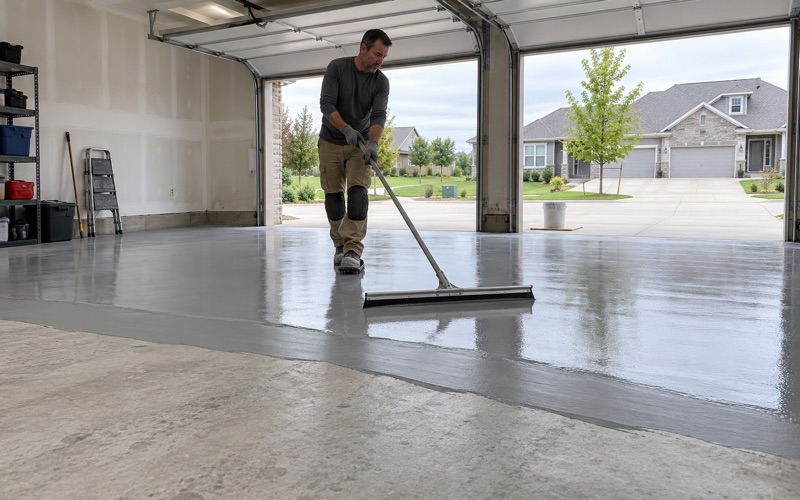
A gray epoxy base coat being pulled out with a floor squeegee across the ground slab of an attached garage in a newer Davenport subdivision.

Epoxy Garage Floor

Ground, moisture-tested epoxy garage floors with flake or solid color and a UV-stable topcoat, built for road salt and winter slush.

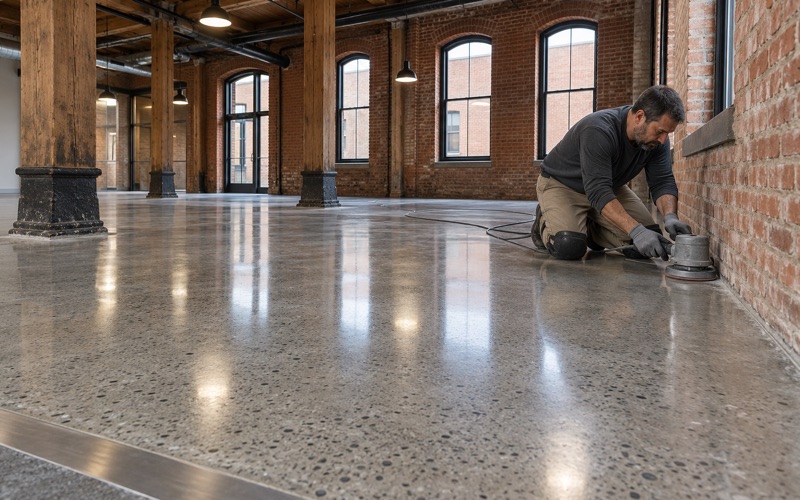
An edge polisher working the last strip along a brick wall on a polished concrete floor in a converted downtown Davenport warehouse.

Polished Concrete Floors

Diamond-ground, densified polished concrete for warehouses, retail floors, offices and basements, with the aggregate exposure chosen up front.

Storage bins being set back on shelves the same afternoon a polyaspartic flake floor was installed in a Davenport garage.

Polyaspartic Floor Coating

Fast-curing, UV-stable polyaspartic floor coatings for garages, shops and storefronts, installed over a ground slab with the moisture tested first.

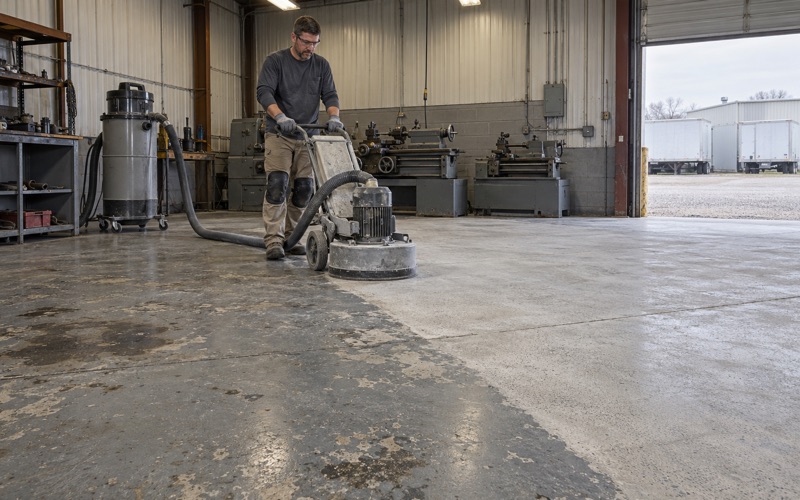
A walk-behind planetary grinder opening an old painted slab in a Davenport machine shop, half the floor ground to bare concrete.

Concrete Grinding

Diamond grinding and shot blasting that strips old coatings and glue, levels lips and leaves a measured profile ready for a new floor system.

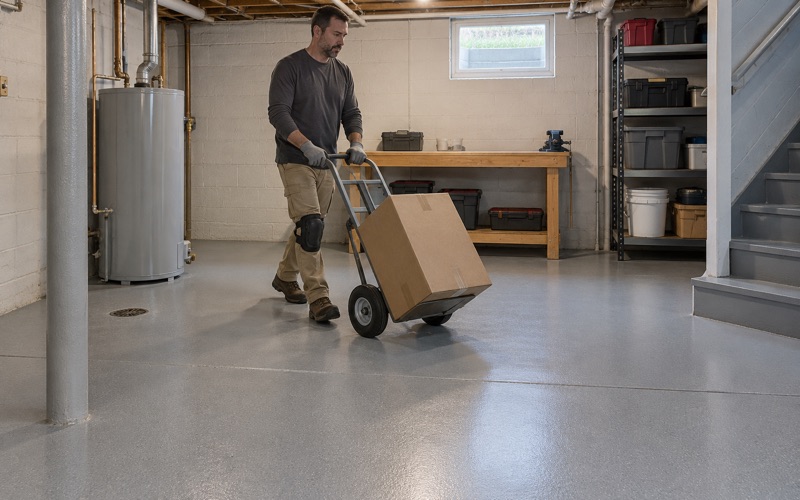
A hand truck wheeling a box across a new light gray epoxy basement floor in an older Davenport house, the floor drain left open in the coating.

Basement Floor Epoxy

Basement floor coatings that start with a moisture test and a look at drains, sump pits and old paint, so the floor bonds and stays bonded.

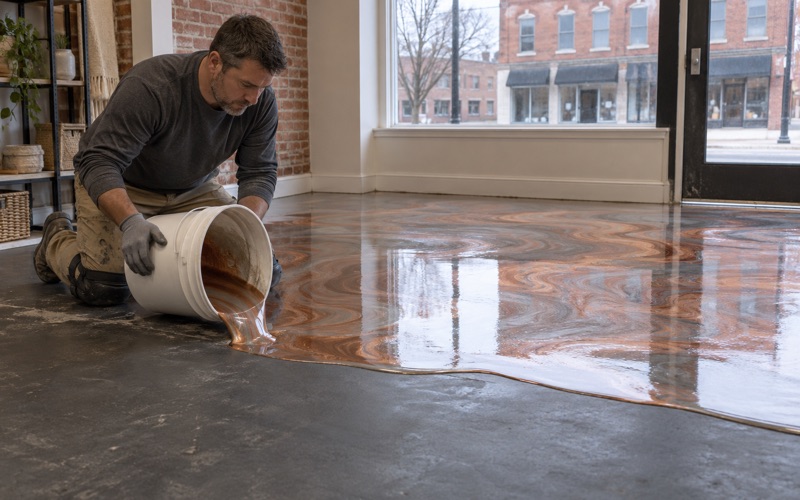
A pearl and copper metallic epoxy being poured onto the floor of a small Davenport boutique, the pigment spreading in soft swirls.

Metallic Epoxy Floor

Marbled metallic epoxy floors for showrooms, finished basements and garages, installed over a ground, flat slab with a clear protective topcoat.

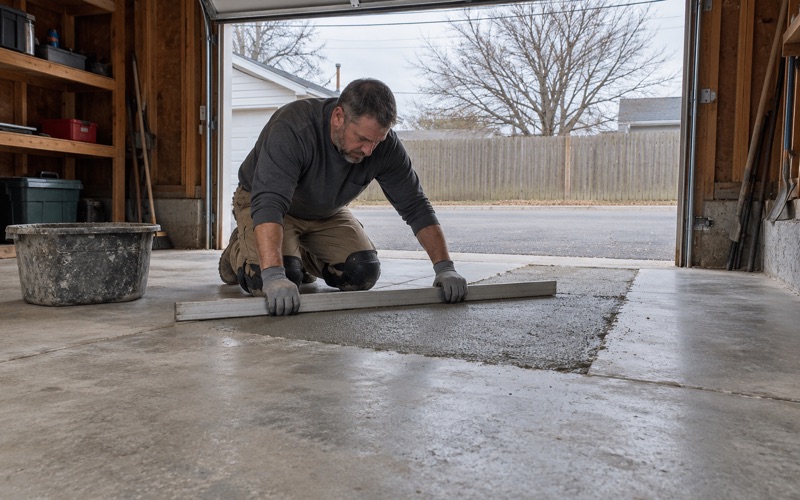
A straight screed bar drawn across a fresh mortar patch where a salt-scaled garage slab in Davenport was cut out at the threshold.

Concrete Floor Repair

Crack filling, spall rebuilding, salt-scaling repair and trip-hazard grinding for garage, basement and shop slabs, with honest advice on replacement.

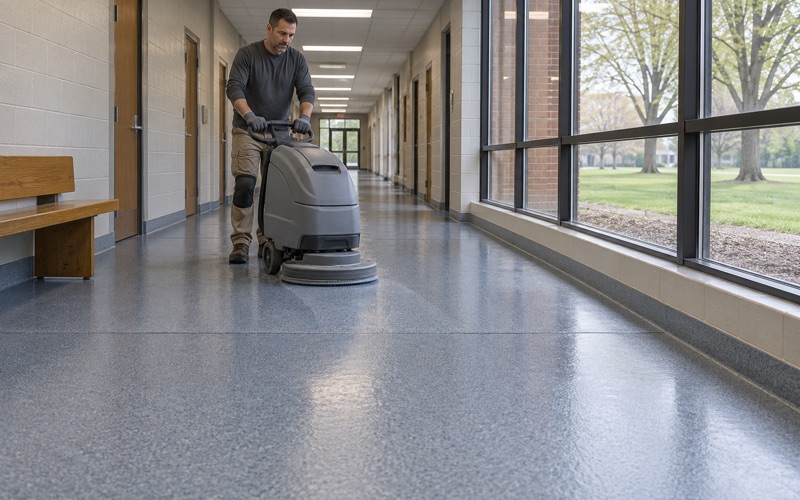
A walk-behind scrubber cleaning a new quartz-textured epoxy corridor in a Davenport school, the coved base turning up the wall.

Commercial Epoxy Flooring

Epoxy and polyaspartic floors for stores, offices, clinics and service shops, phased around business hours with insurance paperwork ready.

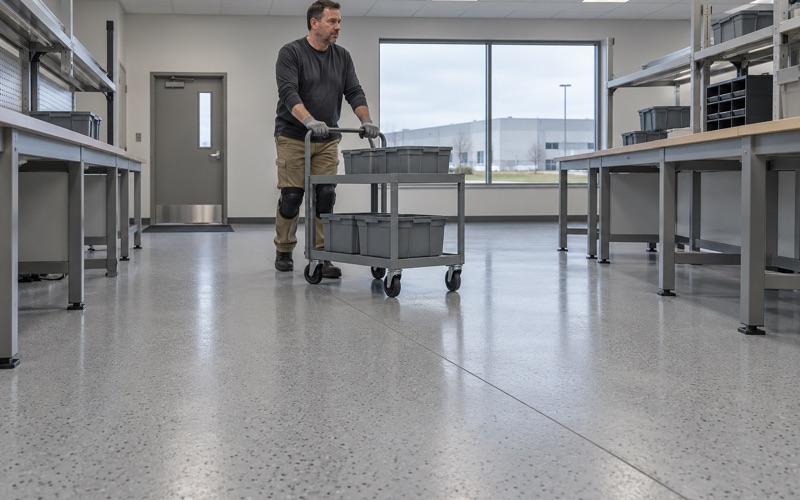
A parts cart rolled across a static-dissipative epoxy floor in an electronics assembly room at a Davenport industrial park.

ESD Flooring

Static-dissipative and conductive epoxy floors for electronics work, server rooms and labs, grounded and resistance-tested before handover.

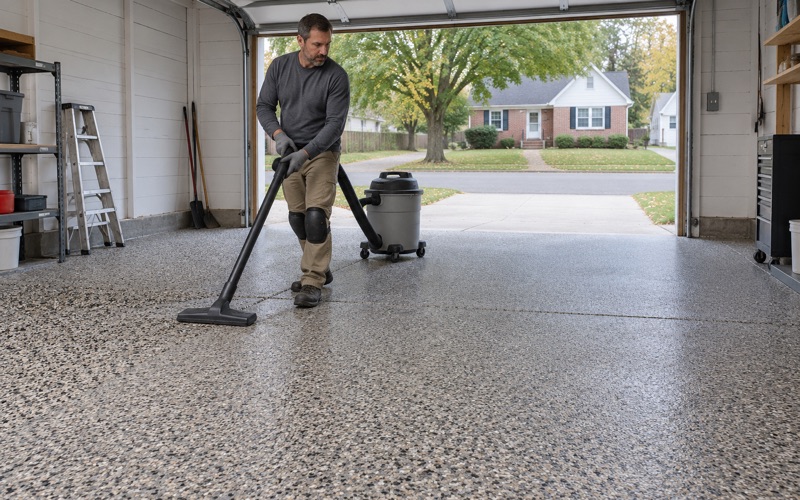
A shop vacuum pulled across a just-scraped vinyl flake floor in a Davenport garage before the clear topcoat goes on.

Flake Epoxy Floor

Full-broadcast vinyl flake floors for garages, basements and shops that hide salt film and dust and wipe clean under a clear topcoat.

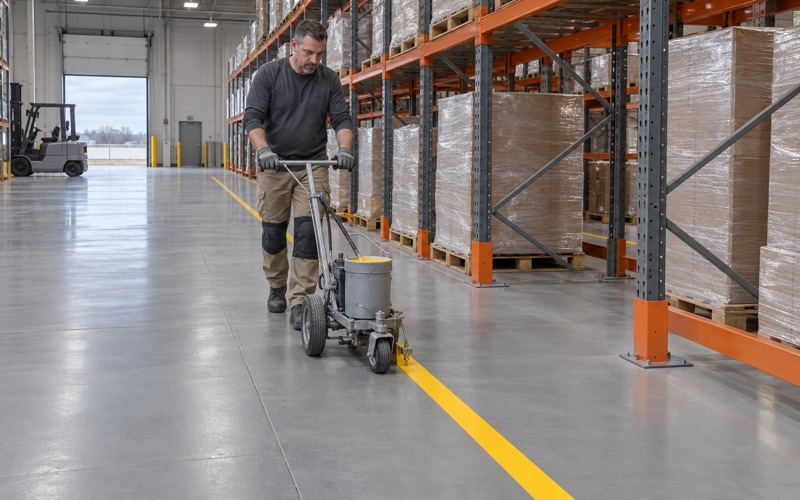
A walk-behind line striper laying a yellow aisle line on a new gray epoxy floor in a Davenport distribution warehouse.

Industrial Epoxy Flooring

Heavy-duty epoxy, urethane cement and chemical-resistant floors for plants, warehouses and shops, installed around shifts and production schedules.

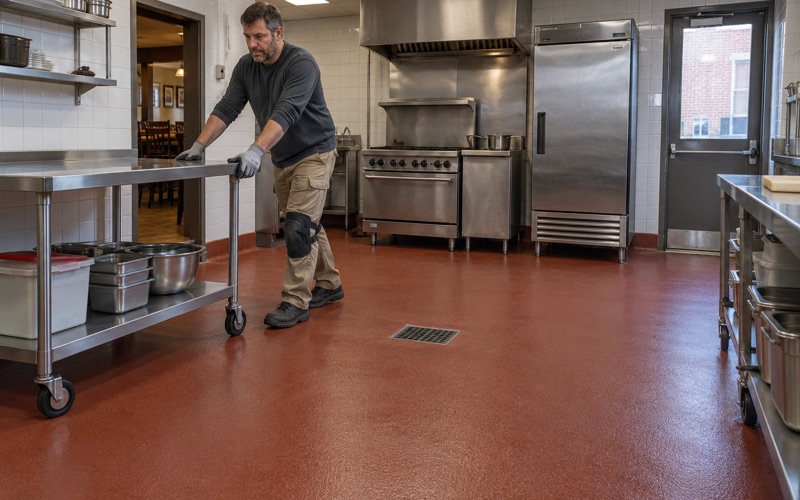
A stainless prep table rolled back into place on a new red urethane cement floor with a coved base in a Davenport restaurant kitchen.

Commercial Kitchen Flooring

Seamless kitchen floors with coved bases, slip-resistant texture and heat-tolerant urethane cement, planned around the Food Code and inspections.

Twenty Years on Quad Cities Concrete

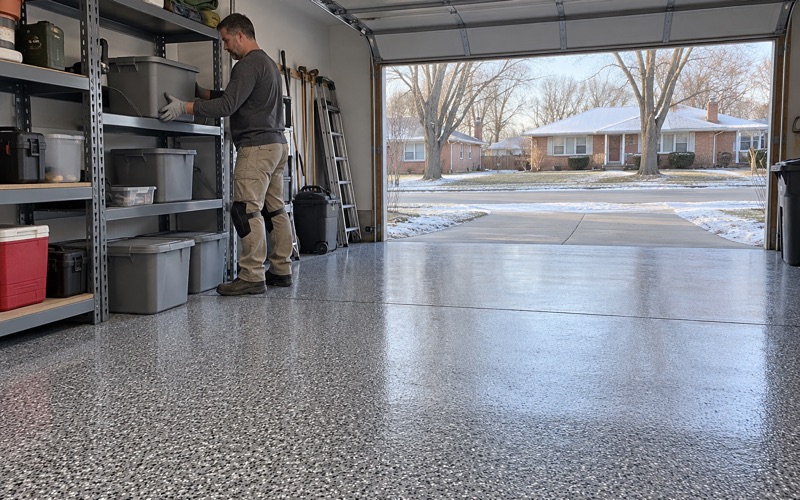
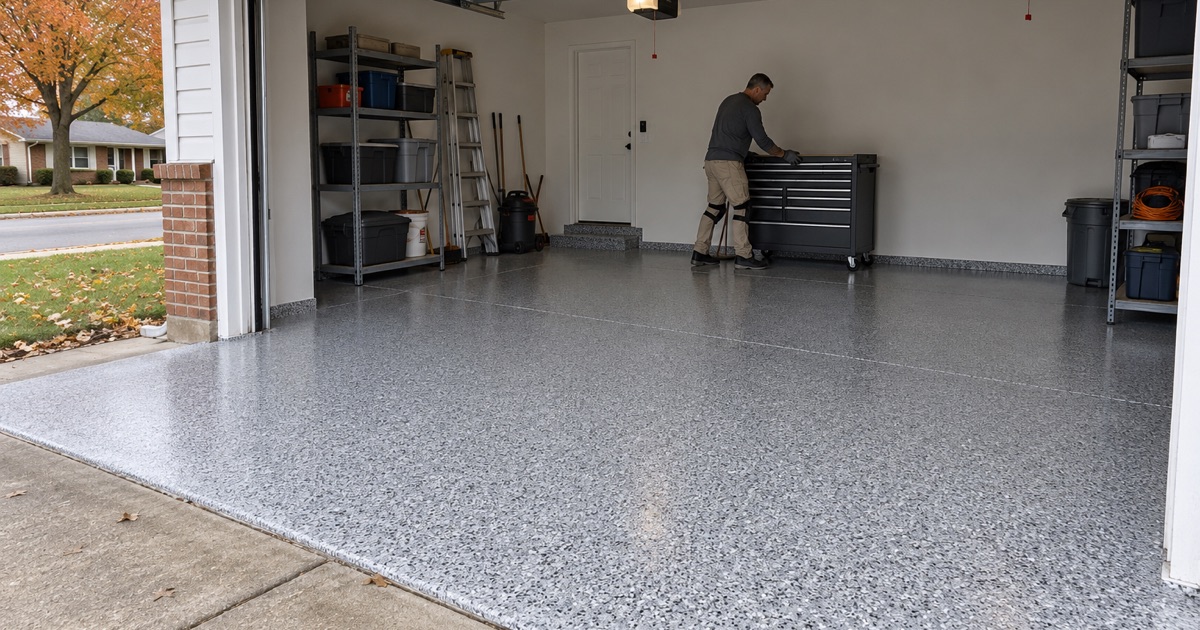
A finished gray, white and black flake floor in the attached garage of a 1960s brick-and-siding ranch in north Davenport, a tool chest rolled back into place.

20+ Years Coating Concrete Floors

Two decades of grinding, priming and coating slabs means we have seen most of the ways a floor coating fails, from hot tire pickup in a garage to a basement coating lifted by water pushing up from below. That history is why our proposals spend as much time on the condition of the slab as they do on the color chart, and why the moisture test comes before the price.

Why Choose Davenport IA Epoxy Flooring

Mechanical Surface Prep, Never Acid

Every slab is opened with a diamond grinder or a shot blaster to a stated ICRI concrete surface profile, so the primer bites into clean, open concrete rather than sitting on the weak, chalky film an acid etch leaves behind and peeling the first time a warm tire turns on it.

Moisture Tested Before the Price

No garage, basement or shop slab is priced until a moisture test is in the scope, using ASTM F1869 calcium chloride kits or ASTM F2170 in-situ probes, because creek-bottom lots and old riverfront basements in Davenport can push enough vapor to blister a coating that a quick visual check would have approved.

Cure Schedules Set by Dew Point

Davenport averages 135.8 nights a year at or below 32 degrees, so our cure windows follow the slab temperature and the dew point spread at its surface rather than the calendar. An unheated garage in January is told to wait for spring instead of being coated cold and left with amine blush and a soft film.

Salt-Ready Garage Floor Systems

Garage floors here are built for the brine and rock salt that ride in on tires from November to March, with a ground base, a full-build epoxy or polyaspartic body and a sealed topcoat, so calcium chloride sits on a closed surface rather than soaking into thin roll-on paint.

Two States, Quoted Separately

Iowa-side and Illinois-side jobs are each quoted under that state’s own coating rules, with Illinois Part 223 VOC limits applied across the river, and low odor is offered as a comfort choice rather than sold as an Iowa legal requirement the way some quotes frame it.

Warranty Exclusions Up Front

What a coating warranty leaves out is explained before the job is sold, with moisture vapor transmission and hydrostatic pressure named first, so a basement owner knows exactly where the coverage stops rather than finding out after water lifts the floor.

The Garage Floor, Start to Finish

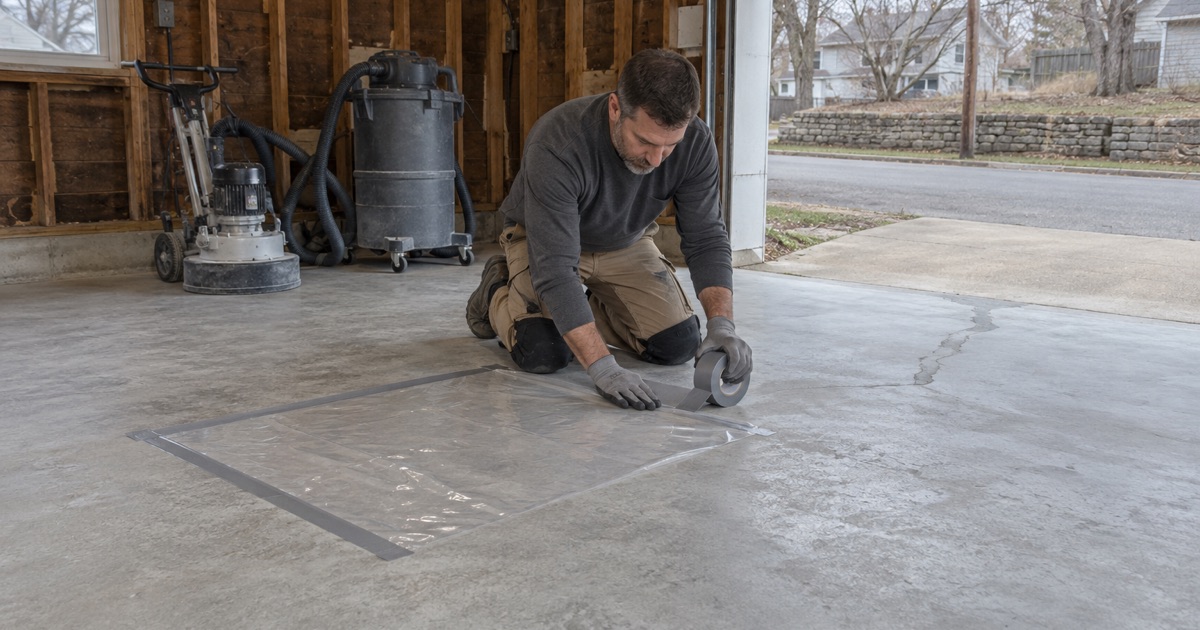
A square of clear plastic being taped to a freshly ground garage slab in Davenport to check for moisture before any coating goes down.

Epoxy Garage Floor Installation, Step by Step

A typical epoxy garage floor starts with a walk-through and a moisture test, then a day of diamond grinding, crack filling and priming. The body coat and any flake broadcast follow, then the clear topcoat, and the car stays out until the cure schedule for that slab temperature says it can come back. Knowing the sequence ahead of time lets you plan where the vehicles, bikes and freezer will live for the week.

Attached Garages and Keeping Dust Out of the House

In an attached garage the house door is a few feet from the grinder, so we capture dust at the machine with a vacuum and seal the door and any return-air openings before work starts. Low-odor polyaspartic and water-based primers are available when someone at home is sensitive to smell. A detached garage gets the same dust capture without the extra masking, and grinding dust is never rinsed toward a floor drain or the street.

Moisture Testing a Garage Slab Before Coating

A garage slab can look dry and still move vapor up from the ground, which lifts a coating in bubbles within a season or two. We use the ASTM D4263 plastic sheet test as a quick screen and calcium chloride or relative humidity probes when we need a number. The reading then decides the primer, so the coating is matched to the slab rather than to a brochure.

Why a Newer House Can Have a Wetter Garage Slab

Many people assume a new house means a dry garage, but the residential code’s IRC R506.2.3 exception lets a garage slab go down without the vapor retarder required under living space. That means a five-year-old garage can test wetter than an older one that happens to sit on a sheet of plastic. We test every garage the same way, whatever the age of the house.

Garage Cracks, Spalls and When to Replace the Slab

Hairline shrinkage cracks are routed and filled before coating, and spalled spots are rebuilt with a repair mortar so the finished floor reads flat. A slab that has heaved, sunk unevenly or is breaking up across large sections is a different conversation. We will tell you when replacement is the honest answer rather than coating over a floor that is still moving.

Road Salt, Brine and Bare Garage Concrete

Calcium chloride and rock salt deicers dissolve into the slush on your tires and soak into bare concrete, where each freeze-thaw cycle pops small flakes off the surface. That scaling is what many older garage floors around Davenport show along the tire lanes. A sealed coating keeps the salt water from getting into the slab in the first place, and it rinses off instead of soaking in.

Cold-Weather Garage Floor Coating Installs

Epoxy needs warmth to cure properly, and an unheated garage in an Iowa winter often cannot hold the slab temperature the product sheet calls for. With a median last spring frost around April 23 and a first fall frost around October 15, we book most unheated garages inside that window. Polyaspartic systems and temporary heat stretch the season only where the slab readings allow it.

Hot Tire Pickup on Bargain Coatings

Hot tire pickup is when a warm tire softens a thin coating, grips it and lifts it as the car pulls away, leaving bare patches in the tire lanes. It happens most to thin water-based kits laid on an unground slab. A mechanically profiled surface with a full-build 100% solids epoxy or polyaspartic body is what prevents it.

Big-Box Epoxy Kits Compared With a Professional Floor

A big-box kit is mostly a thin water-based epoxy over an acid-etched slab, with a small bag of flakes. A professional floor is ground to a measured profile, built in multiple coats to a stated thickness and finished with a UV-stable clear coat. That is usually the difference between a floor that peels after one winter and one that holds up through many.

Epoxy Garage Floor Cost and What Moves the Price

Garage floor pricing moves mainly with square footage, the condition of the slab, the amount of crack and spall repair, the system chosen and any old coating that has to be ground off. A moisture problem that calls for a mitigation primer also adds cost. That is why we test before we give you a final number, rather than discovering the extra work halfway through the job.

Basements, Floor Drains and Damp Slabs

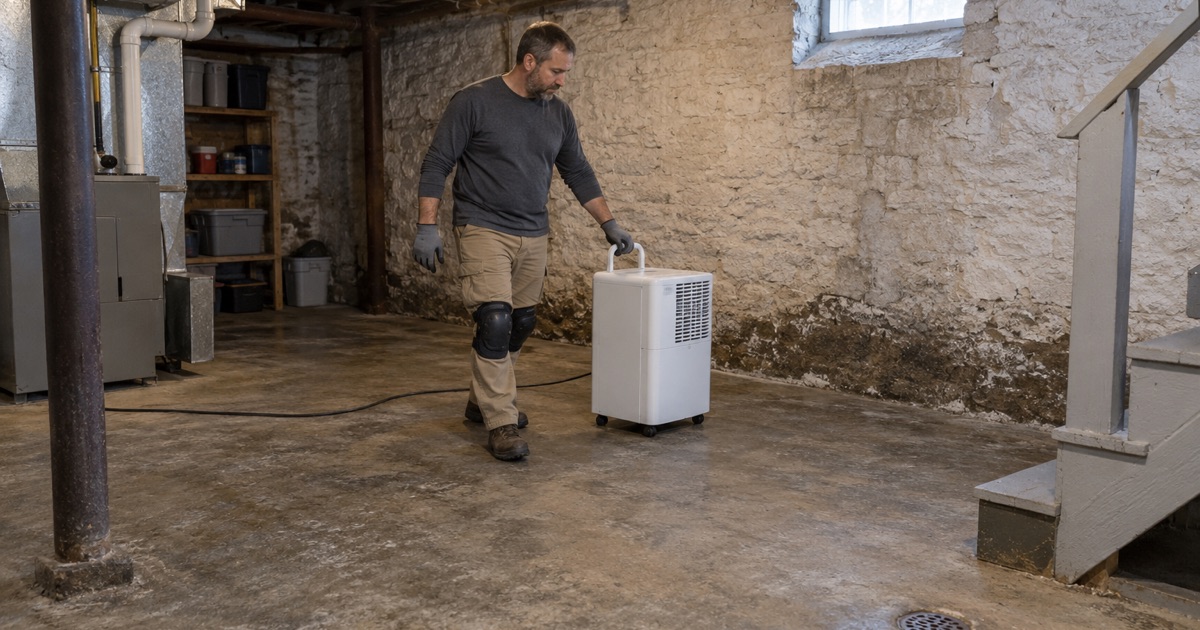
A dehumidifier being wheeled across a damp old basement floor in Davenport, white efflorescence along the foundation wall, before any coating is chosen.

Coating an Old Basement Floor, Moisture First

Before anything goes on an old basement floor, we read it for past water: stains along the walls, rust around the drain, efflorescence and patched cracks. Davenport has a lot of these floors, since 69.7 percent of its housing was built before 1980 and 24.0 percent before 1940. The moisture question comes first on almost every basement job we look at.

Sump Pits, Drain Tile and Basement Floor Drains

A coated basement floor has to meet the floor drain and the sump pit cleanly so water still runs where it should. We feather the coating into the drain body and leave the sump lid and any drain tile openings clear. Sealing over drainage only moves the water somewhere it can do more harm.

Paint, Patches and Tile Glue on Old Basement Floors

Old basement slabs often carry several layers of floor paint, patches of different mixes and black mastic from removed tile. Each of these has to come off with grinding before a new system goes down. A coating only bonds as well as the weakest old layer underneath it, so leaving any of it in place is a gamble.

Efflorescence on a Basement Floor

White powder on a basement floor is efflorescence, salt carried up through the concrete by moving water and left behind as it evaporates. It tells us the slab has had water pass through it. That finding triggers a quantitative moisture test and usually a moisture-mitigation primer rather than a straight epoxy coat.

Moisture-Mitigation Primers for Basement Slabs

When vapor emission or relative humidity runs above what a standard epoxy tolerates, a moisture-mitigation primer goes down first as its own layer. These primers are rated for high vapor readings, but they are not built for liquid water pushing up under pressure. The test result decides whether a coating is the right answer at all.

Riverfront Basements and Water From the Storm Sewers

In 2019, downtown Davenport basements took water from below as the high river pushed up through the storm sewers and the water table rose. That is hydrostatic pressure, not vapor, and no coating’s moisture rating covers it. On riverfront buildings we tell you plainly when a floor coating cannot be the fix.

Coating a Basement After Water Gets In

After a basement has taken water, the slab needs time and steady air movement to dry before a coating has a chance. We retest after the drying period and schedule the install only once the readings are back inside the product’s limits. Trapping moisture under a fresh film just sets up the next failure.

Basement Coating Warranties and Their Exclusions

Nearly every coating warranty excludes failures caused by moisture vapor transmission and hydrostatic pressure, which are the two most likely problems in a basement. We go through those exclusions before you sign. That way you know what the warranty covers, and why the moisture test matters so much on a below-grade slab.

A Floor Coating Is Not Radon Mitigation or Waterproofing

A coated floor can look sealed, but it is not radon mitigation, waterproofing or flood protection. Radon work in Iowa is credentialed separately under Iowa Code chapter 136B, and stopping water takes drainage and grading. We sell a floor coating only for what it does on the dry days.

Color, Flake and Finish

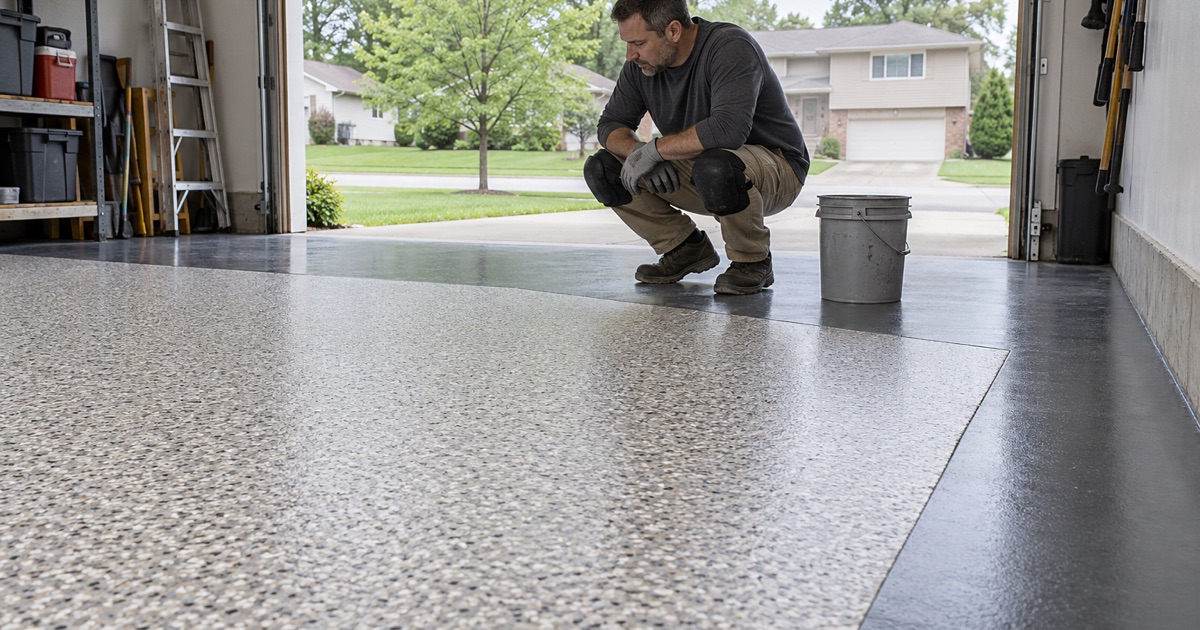
A finished Davenport garage floor with a light flake field and a solid charcoal border band separated at a saw-cut line, inspected at the threshold.

Vinyl Flake Epoxy Floors and Chip Size

A flake epoxy floor broadcasts vinyl chips into a wet base coat, then seals them under a clear topcoat. Blend and chip size change the look a great deal. Small chips read as a fine speckle, while larger ones hide more of the base color and do a better job of masking dust and small imperfections between cleanings.

Metallic Epoxy Floors and the Marbled Look

Metallic epoxy uses pearlescent pigments that move in the wet resin, creating swirls and depth that look like poured stone. It needs a very flat, clean slab and a careful installer, because every roller mark and trowel stroke shows. We use it mostly for showrooms, finished basements and garages where the look matters most.

Polished Concrete and Exposed Aggregate

Polished concrete is ground in stages with finer diamonds and hardened with a lithium silicate densifier rather than coated. How deep the first grind goes decides how much stone shows, from a cream finish with almost no aggregate to a salt-and-pepper look or full exposure. The choice has to be made at the start, since aggregate cannot be hidden again once it is cut open.

Gloss, Satin or Matte Floor Sheens

High gloss looks sharp but shows dust, footprints and tire marks quickly, especially in a garage. Satin topcoats hide more of that and still clean easily. Matte finishes suit offices and showrooms where glare from windows or overhead lights is a problem.

Quartz Broadcast Floors for Color and Grip

Quartz aggregate broadcast into epoxy gives color and texture in one step, then gets locked in with a clear topcoat. It is a common choice for locker rooms, kitchens and wet areas where you want a floor that resists slipping without the look of a plain industrial coating.

Solid Color Epoxy Coatings

A solid gray or tan floor is often the right choice for a shop, a utility room or a warehouse aisle. It is easy to clean, simple to repair and shows dropped parts and fluid leaks right away. Many working floors need that more than decoration.

Sunlight, UV Exposure and Ambering

Many epoxies yellow, or amber, under sunlight coming through a garage door or a window. A UV-stable polyaspartic or polyurea topcoat over the epoxy keeps the color steady. That matters most on west-facing garages and showrooms with large windows.

Saw-Cut Lines, Borders and Floor Logos

Saw-cut joint lines, contrasting borders and inset logos can turn a plain floor into a showroom or branded lobby. We lay them out before the base coat and line them up with the slab’s control joints. That way the design follows the floor’s own movement rather than cracking along a random line.

Plants, Warehouses and Commercial Floors

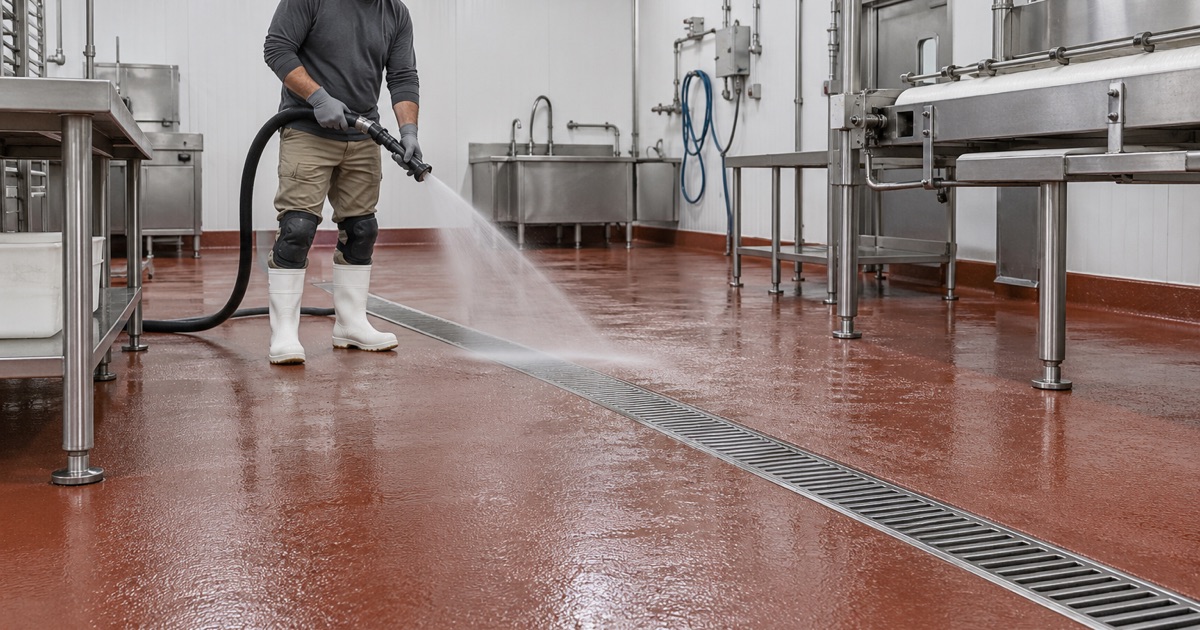
A hot-water hose washdown across a textured urethane cement floor in a Davenport food plant, the water running to a stainless trench drain.

Commercial Epoxy Flooring Versus Residential Jobs

Commercial floors bring larger areas, tighter schedules, permits, insurance certificates and owners who cannot shut down for a week. We carry the certificate of insurance a permit office asks for and explain the state registration and city licensing rules that apply. We do not claim a credential we do not hold.

Industrial Floors for Oil, Coolant and Hydraulic Fluid

Manufacturing floors take oil, coolant, hydraulic fluid and dropped steel parts every shift. A chemical-resistant epoxy body with a tough topcoat, installed thick enough to take impact, keeps those fluids on the surface where they can be cleaned up. Plants along the I-80 corridor, including the Eastern Iowa Industrial Center, are the kind of floors this work is built for.

Warehouse Floors Under Forklifts and Pallet Jacks

Forklift and pallet jack traffic wears coatings in narrow lanes and at turning points. We spec thicker builds and harder topcoats in those paths. Many warehouses choose polished concrete for open storage areas, where a coating would wear through and need recoating on a regular cycle.

Food Plant Floors and Washdown Cleaning

Food processing floors are cleaned with hot water, steam and strong chemicals that break down ordinary epoxy over time. Those floors need a system rated for thermal shock and the cleaners actually in use. Slope toward the drains matters too, so water does not stand on the surface between shifts.

Urethane Cement for Heat and Harsh Cleaners

Urethane cement is a heavy-duty system that tolerates hot water, thermal cycling and many food acids far better than a standard epoxy. It is the usual pick for commercial kitchens, breweries and food plants where an epoxy floor would soften and fail.

Farm Shops and Equipment Dealer Service Bays

Farm shops and dealer service bays see tractors, combines, mud, hydraulic oil and the same road salt as a home garage. A ground, built-up epoxy or polyaspartic floor with a light texture takes that traffic and still washes down quickly between jobs.

Restaurant Kitchen Floors and the Food Code

Restaurant kitchens in Davenport are inspected by the Scott County Health Department under the 2017 FDA Food Code as adopted in Iowa. We plan coved bases under Food Code 6-201.13, a texture suited to wet areas and clean transitions around floor sinks and grease interceptor access. The city’s building permit application also asks food establishments for county approval first, so we plan the floor around that step.

Office, Clinic and Showroom Floors

Offices, clinics and showrooms need floors that look finished and clean easily, not just ones that survive traffic. Metallic epoxy, polished concrete and solid-color systems with a satin topcoat all work well there. We can phase the work around business hours so the space stays usable.

Iowa and Illinois VOC Rules for Floor Coatings

The national architectural coatings rule in 40 CFR 59 Subpart D sets a baseline for VOC content, and Illinois adds its own Part 223 limits for floor coatings on Illinois-side jobs. We choose products that meet the rules on each side of the river. Each job is quoted under the state where the floor actually sits.

Night and Weekend Floor Installs for Businesses

Many plants, shops and kitchens cannot close for a week of floor work. We phase commercial floors around shifts and production, using overnight and weekend windows and faster-curing systems. The space can reopen as soon as the coating is ready to carry traffic.

Areas We Serve

Davenport IA Epoxy Flooring provides epoxy-flooring throughout the greater Davenport area, with the same crews and the same standards on every job.

Good to know

Frequently Asked Questions

How much does an epoxy garage floor cost in Davenport?

The price depends mostly on the square footage, the condition of the slab, how much crack and spall repair it needs, whether an old coating has to be ground off and which system you choose. A slab that tests high for moisture may also need a mitigation primer. We give you a written quote after the walk-through and moisture test, listing the product line, coat count and finished thickness.

How long does an epoxy floor installation take?

Most two-car garage floors take two to three working days, including grinding, repairs, priming, the body coat and the topcoat. Basements with old paint or tile glue, and commercial floors phased around a business, take longer. Cure time after the last coat is separate and depends on the product and the slab temperature.

How soon can I drive on a new epoxy garage floor?

Foot traffic is usually fine within a day, but vehicles should wait until the coating reaches its full cure, which the product sheet sets by temperature. In a cool garage that wait is longer. We give you a specific date for parking based on the system used and the conditions in your garage during the cure.

Do you test the slab for moisture before coating?

Yes. A moisture test is written into every garage, basement and shop quote before the price is final. We use the ASTM D4263 plastic sheet test as a screen and ASTM F1869 calcium chloride kits or ASTM F2170 relative humidity probes for a number, then choose the primer that the reading calls for.

Is epoxy or polyaspartic better for a garage floor?

Many of our garage floors use both: a 100% solids epoxy body coat for build and adhesion, then a polyaspartic topcoat that resists UV yellowing and abrasion. A full polyaspartic system cures faster and tolerates cooler temperatures, while epoxy gives more working time and thickness. We recommend a system once we know the slab and how you use the space.

Are you licensed for floor coating work in Iowa and Illinois?

Iowa registers contractors under Iowa Code chapter 91C, and Davenport licenses construction contractors under City Code chapter 15.30, while Illinois-side cities set their own rules. We explain which requirements apply to your job and provide the certificate of insurance a permit office asks for on commercial projects, rather than quoting a credential on this page.

Can you install an epoxy floor in winter?

Heated garages, basements and commercial spaces can be coated year-round as long as the slab temperature and dew point spread stay within the product limits. Unheated garages often cannot hold those conditions in a Davenport winter, so we usually schedule them between late spring and mid-October rather than risk a soft, blushed coating.

Will a coated floor be slippery when wet?

A smooth high-gloss coating can be slick with water, snowmelt or oil on it. Flake and quartz broadcast systems add texture, and an anti-slip additive can be mixed into the topcoat for garages, entryways and wet rooms. We match the texture to the space so it cleans easily and still gives your feet some grip.

Can you coat over old floor paint or an existing epoxy?

Sometimes, but only after testing how well the old layer is bonded. Loose paint, peeling epoxy and tile mastic have to be ground off, because a new coating is only as strong as whatever it sits on. Sound, well-bonded epoxy can sometimes be ground and recoated, which we confirm during the walk-through.

How do I take care of an epoxy floor?

Sweep or dust-mop regularly so grit does not scratch the topcoat, and clean with a pH-neutral cleaner and a soft mop or auto scrubber. In a garage, rinse road salt and slush off before they dry into a film. Mats under heavy equipment and felt pads under furniture help a basement or showroom floor keep its finish.

Ready to Get Started?

Request a free quote today and we'll get back to you fast.